
M.CRAFT City Osaka.P vs Osaka.S: 26° vs 43° Toe Hang
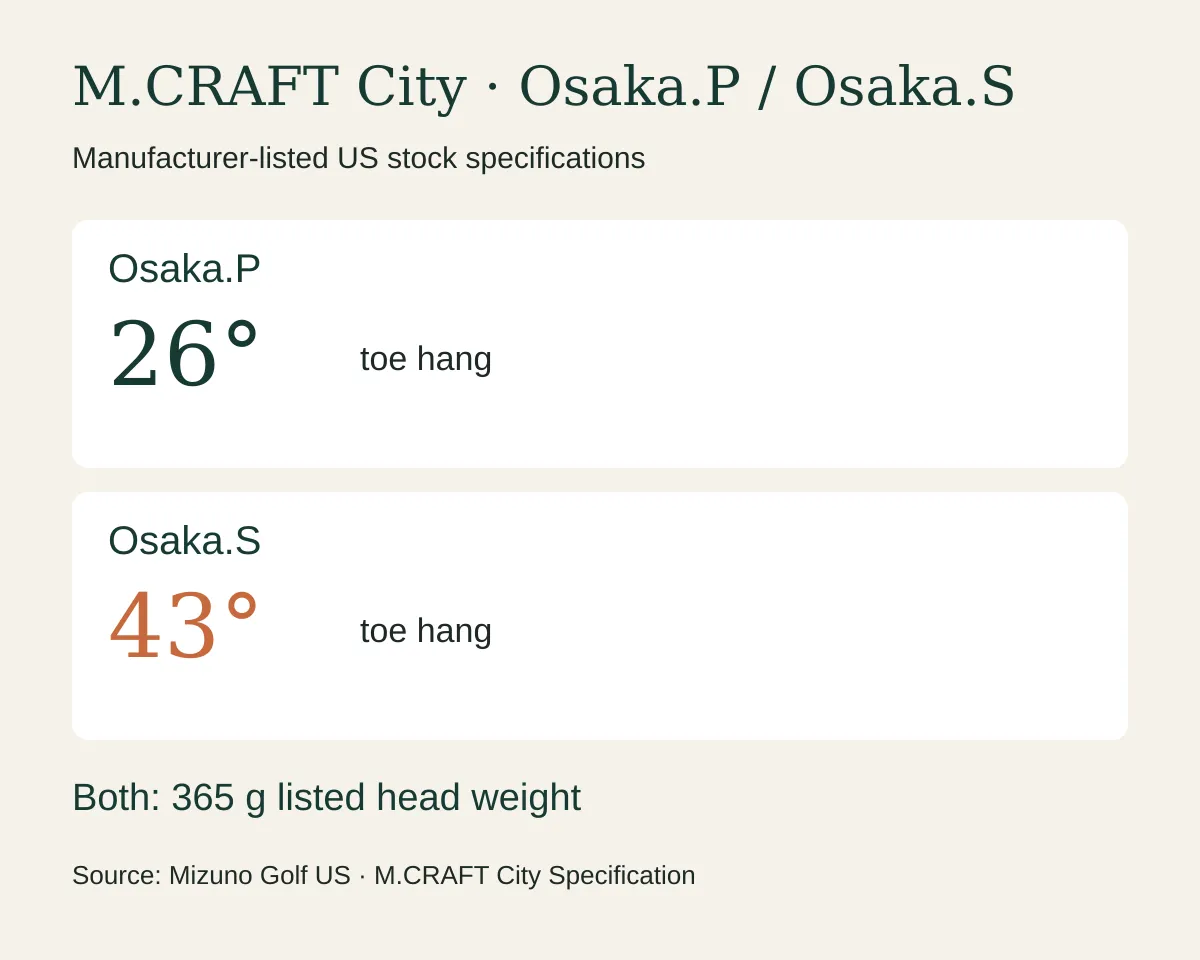
M.CRAFT City Osaka.P vs Osaka.S comes down to a documented toe-hang difference: Mizuno lists 26° for Osaka.P and 43° for Osaka.S, with the same 365 g head weight. Both list 34- and 35-inch lengths, 3° loft and 70° lie. Keep the full suffix when researching a listing; “Osaka” alone doesn't identify which configuration those figures describe. Source: Mizuno Golf US, M.CRAFT City Specification.
What differs between M.CRAFT City Osaka.P and Osaka.S?
Osaka.S has 17° more manufacturer-listed toe hang than Osaka.P. Toe hang describes how far the toe points down when the shaft is supported horizontally and the head is free to rotate into its resting position. It is a balance description, not a measurement of head weight or a promise about how a particular golfer will putt.
| Listed specification | Osaka.P | Osaka.S |
|---|---|---|
| Toe hang | 26° | 43° |
| Head weight | 365 g | 365 g |
| Lengths | 34, 35 inches | 34, 35 inches |
| Loft | 3° | 3° |
| Lie | 70° | 70° |
| Handedness | Right only | Right only |
Mizuno's US specification table supplies every value above. Its accompanying stock-build notes also list the same KBS CT Tour shaft and Lamkin Deep Etched Grey Cord grip for both configurations. Head weight means the head, not the assembled club's total weight; matching listed weights do not establish identical geometry.
The 26° and 43° figures describe resting balance, not shaft offset or neck/hosel shape. Offset concerns the face’s position relative to the shaft; neck/hosel wording describes the shaft-to-head connection. Mizuno’s cited table has no offset or neck column: keep Osaka.P and Osaka.S as complete configuration names rather than using P/S alone to fill those fields. The RH-only note concerns handedness, separately from balance.
Need a left-handed option rather than either RH-only Osaka configuration? See sourced LH options from Mizuno and other makers. The reference keeps exact builds and their citations separate; combined hand and length lists do not confirm every left-handed length combination.
These are the maker's US stock specifications. Use separate, configuration-specific evidence for neck descriptions, finish, release year, regional availability or an altered build; the suffix and numerical table alone don't establish those details.
What should an Osaka listing supply?
For listing research, ask for evidence that connects the seller's club to the complete configuration name, then document its current build separately:
- Identity evidence: a legible model/configuration label on packaging or purchase paperwork, if available, alongside clear photographs of all head markings. A title typed by the seller is a claim, not supporting documentation.
- Connection views: a side-on close-up showing the complete shaft-to-head connection and an address view looking down at the head. Keep visible observations separate from names inferred from P or S.
- Condition and markings: face, back/cavity and whole-sole photographs, rather than one distant image.
- Current build: measured playing length, shaft and grip details, plus any shortening, reshafting, bending, refinishing or other alteration history. If the seller supplies a toe-hang measurement, ask how it was measured and record it as seller evidence.
Photos help research configuration and condition; they do not authenticate a putter or prove its factory specifications.
Worked example: “Osaka.P, 43° toe hang, 34-inch”
Suppose a listing uses that title. The 34-inch length matches an option listed for both configurations, so it doesn't resolve the identity. The 43° figure matches Mizuno's Osaka.S row, while Osaka.P is listed at 26°.
Keep that discrepancy open rather than relabeling the club immediately. Ask whether 43° was copied from a specification page or measured on this putter, request the full configuration evidence, and check the alteration history. A copied number, an incorrect title and a changed build require different follow-up evidence.
Copyable seller request:
Could you confirm whether this is M.CRAFT City Osaka.P or Osaka.S and show any packaging or purchase record identifying the full configuration? Please send clear face, back/cavity, whole-sole, address and side-on shaft-to-head connection photos. What is the measured playing length, and has it been shortened, reshafted, bent or refinished? Is the stated 43° toe hang copied from a source or measured on this club? Please include the source or measurement method.
Keep the two configurations and their sources together
PutterDB's free reference has separate M.CRAFT Osaka.P and M.CRAFT Osaka.S records and a preselected Osaka.P vs Osaka.S comparison with field-level citations.
Review the Osaka.P and Osaka.S manufacturer sources in private browser notes instead of retyping the two configuration references. Both candidates retain their own Mizuno attribution even though they cite the same US table; they are not the listing’s resolved identity. Review them, then choose add evidence, replace documented sources only or cancel; cancel preserves your local draft. Seller claims, listing identity, observations and photo requests remain untouched. Enter the actual suffix and seller’s toe-hang claim yourself, and keep the unanswered identity question separate from Mizuno’s stock values. Supplied PutterDB review/retrieval dates are not your source-viewed dates.
For manual entry, open browser notes without proposed evidence, blank if no draft is saved. Prefer a PDF? Choose the free fillable or printable A4/Letter worksheet; no signup or email is required.