
Studio Stainless Newport 2 vs 2.5: Flat vs Flowing Neck
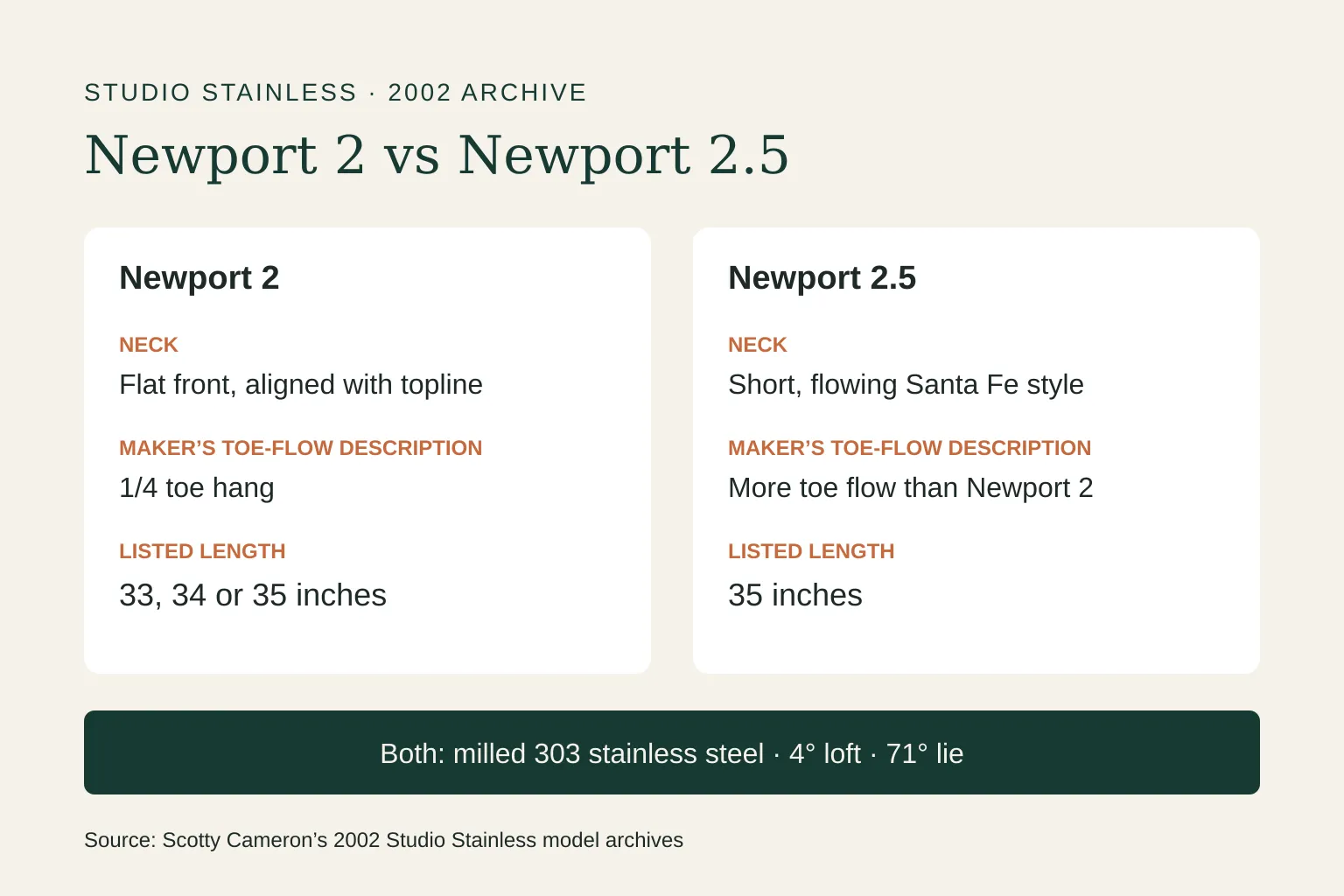
The Studio Stainless Newport 2 vs 2.5 difference is chiefly the neck: the Newport 2 has a flat-front neck aligned with the topline, while the Newport 2.5 has a short, flowing Santa Fe-style neck that the maker describes as providing more toe flow. Both 2002 archive entries specify milled 303 stainless steel, 4° loft and 71° lie. The Newport 2 lists 33-, 34- and 35-inch lengths; the 2.5 lists 35 inches.
Studio Stainless Newport 2 vs 2.5 specifications
These are manufacturer specifications and descriptions from Scotty Cameron’s 2002 Newport 2 archive and 2002 Newport 2.5 archive. They describe those editions, rather than every putter carrying either model name.
| Detail | Studio Stainless Newport 2 | Studio Stainless Newport 2.5 |
|---|---|---|
| Neck | Flat front, aligned with the topline | Short, flowing Santa Fe style |
| Toe-flow description | Maker states 1/4 toe hang | Maker describes more toe flow than the Newport 2 |
| Listed length | 33, 34 or 35 inches | 35 inches |
| Head material | Milled 303 stainless steel | Milled 303 stainless steel |
| Loft / lie | 4° / 71° | 4° / 71° |
| Alignment | Single sightline | Single sightline |
| Finish | Soft beaded mist | Soft beaded mist |
For identifying the variant, compare the neck before relying on the shared finish or sightline. Those two features appear on both models and won't distinguish them on their own.
What does the flowing neck change?
The Studio Stainless Newport 2.5 pairs the Newport 2 head design with a short Santa Fe-style neck that the maker describes as producing more toe flow. The Newport 2 archive specifies 1/4 toe hang; the 2.5 description supplies no numerical angle.
Neck or hosel wording describes the shaft-to-head connection. Shaft offset describes the face’s position relative to the shaft; neither cited 2002 archive gives an offset value, so don't infer one from the neck name or borrow it from a later edition.
Toe hang describes how far the toe points downward when the shaft is supported horizontally and the head is free to rotate into its resting position. Keep neck shape, offset and balance separate, retaining the maker’s “1/4 toe hang” and relative “more toe flow” as written.
If you're researching a putter to play, use the neck and toe-flow difference to decide which one to try. A model name alone doesn't establish which putter suits your stroke.
Keep Studio Stainless separate from Studio Select
The family name matters as much as “Newport 2.5.” Scotty Cameron’s 2011 Studio Select Newport 2.5 archive lists 33-, 34- and 35-inch lengths, 3/4-shaft offset and interchangeable weights. Those details belong to that Studio Select entry, not Studio Stainless.
If the family or complete suffix is missing, open the Newport listing-name finder with unknown choices. Choose only supported wording. Its five candidates cover four 2002 Studio Stainless editions and the 2005 Studio Style Newport, not Studio Select; photo clues guide the next request rather than resolve identity.
How to research a 34-inch Newport 2.5 listing
Say a seller lists a “Studio Stainless Newport 2.5, 34 inches.” Compare the family, neck and sole markings with the archive, then investigate why the reported length differs from the listed 35 inches.
Copyable seller-photo and build request:
Could you send clear photos of the face, cavity/back, legible sole markings and the complete shaft-to-head connection, including a side-on neck close-up? For your “Studio Stainless Newport 2.5, 34 inches” listing, please explain how you measured the current length and whether the shaft has been shortened or replaced. Please also share any records of shaft work, refinishing or other alterations, and the evidence supporting the model family and edition/year.
If you claim a production date, what supports it for this particular club? Please send any dated purchase or build records you have, explain what event each date records, and say if the original build or dating history is unknown.
Use the four-view checklist below to explain what each photo should keep in frame.
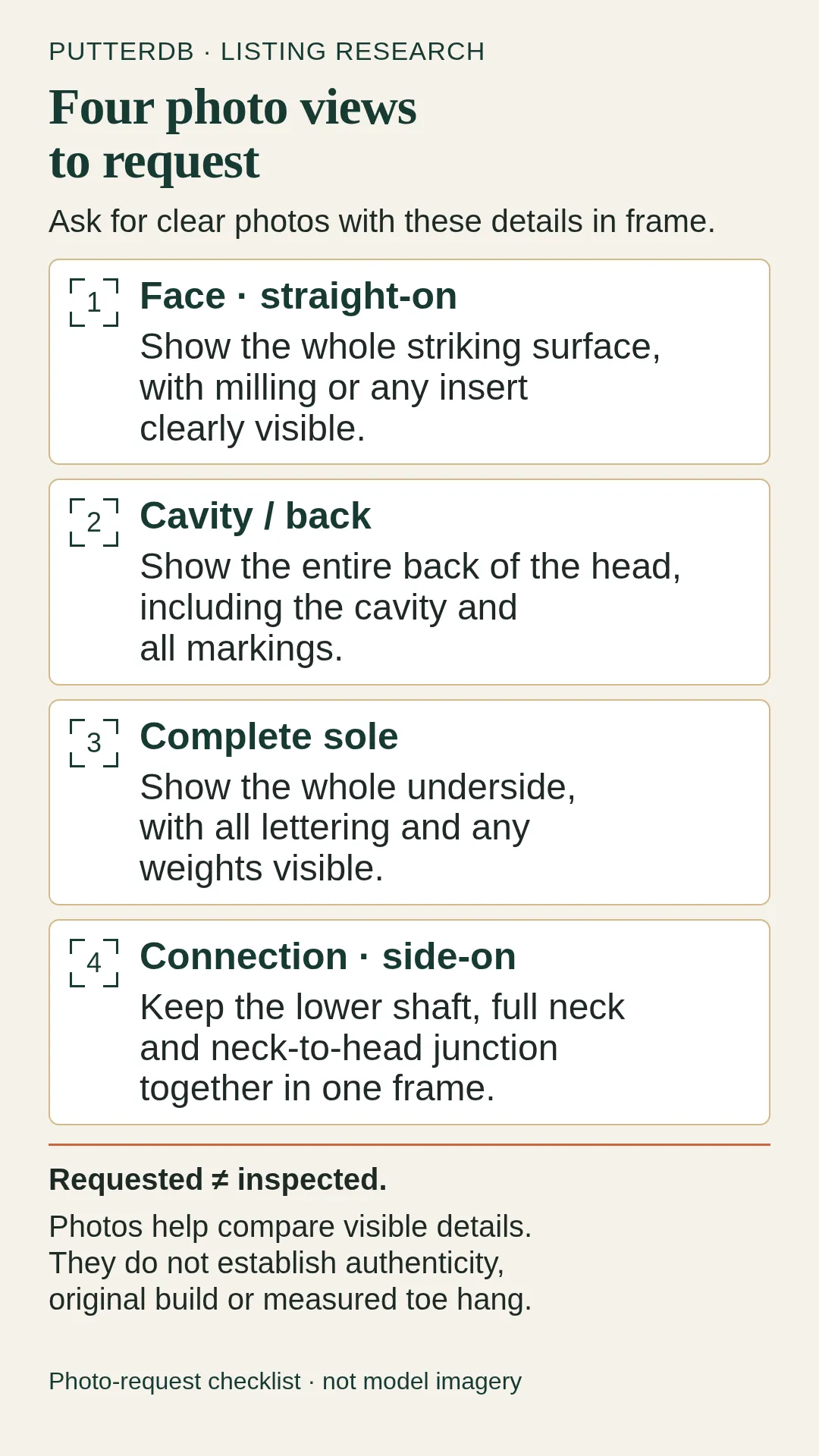
Original checklist graphic by PutterDB; framing guidance, not photographic evidence or a model illustration.
Four photo views to request — text checklist:
- Face — straight-on: Show the whole striking surface, with milling or any insert clearly visible.
- Cavity / back: Show the entire back of the head, including the cavity and all markings.
- Complete sole: Show the whole underside, with all lettering and any weights visible.
- Connection — side-on: Keep the lower shaft, full neck and neck-to-head junction together in one frame. If the connection is obscured, request the opposite side too.
Ask for clear, focused views. “Any insert” and “any weights” are conditional checklist wording, not specifications for these Studio Stainless models.
Keep the research notes specific to the discrepancy:
- Seller statement: “Studio Stainless Newport 2.5, 34 inches,” followed by the measurement method and reported build history. Save the listing URL/ID and date viewed; leave an uncertain edition/year uncertain.
- Manufacturer documentation: “35 inches — Scotty Cameron, 2002 Studio Stainless Newport 2.5 archive.” This is a listed model specification, not a measurement of the seller’s club.
- Observations and questions: identify what each received photo actually shows, keep missing views as requests, and ask “What explains the reported 34-inch length?”
A length discrepancy alone proves neither authenticity nor a particular alteration; photos do not establish authenticity, original build or current length, loft, lie or toe hang. The 2002 archive label identifies the model/edition, not this club’s production date. Keep the seller’s dating claim and club-specific records separate: purchase and shaft-service dates record those events, not necessarily manufacture. Leave production date and original build unresolved unless supported.
Review the two 2002 Newport 2/2.5 archive sources in private browser notes as separate candidates, then confirm any evidence transfer; Studio Select is not selected and seller claims and observations remain yours to enter. Supplied PutterDB review/retrieval dates are not your source-viewed dates. Alternatively, open browser notes without proposed evidence or choose the free fillable or printable A4/Letter worksheet. The hypothetical filled worksheet demonstrates evidence separation using the different 2005 Studio Style Newport / 2002 Studio Stainless Newport pair; use its method, not its specifications.
Is Studio Stainless Newport 2 made from GSS?
The production Studio Stainless Newport 2 in the 2002 archive is specified as milled 303 stainless steel. The archive’s opening discussion of German Stainless Steel, or GSS, refers to Tour predecessors; it doesn't change the material specification of the production model. The Studio Stainless Newport 2.5 entry also specifies milled 303 stainless steel.
If a seller uses “GSS,” ask what evidence supports that material claim for the individual putter rather than transferring the Tour history to a production club.
Keep an edition-specific reference alongside the listing
PutterDB’s free, account-free 2002 Studio Stainless Newport 2 record and Newport 2.5 record link to the maker’s documentation. Open the prefilled Studio Stainless Newport 2 versus 2.5 comparison to inspect their listed specifications and evidence side by side.