
Studio Stainless Newport Beach: The Face Slot
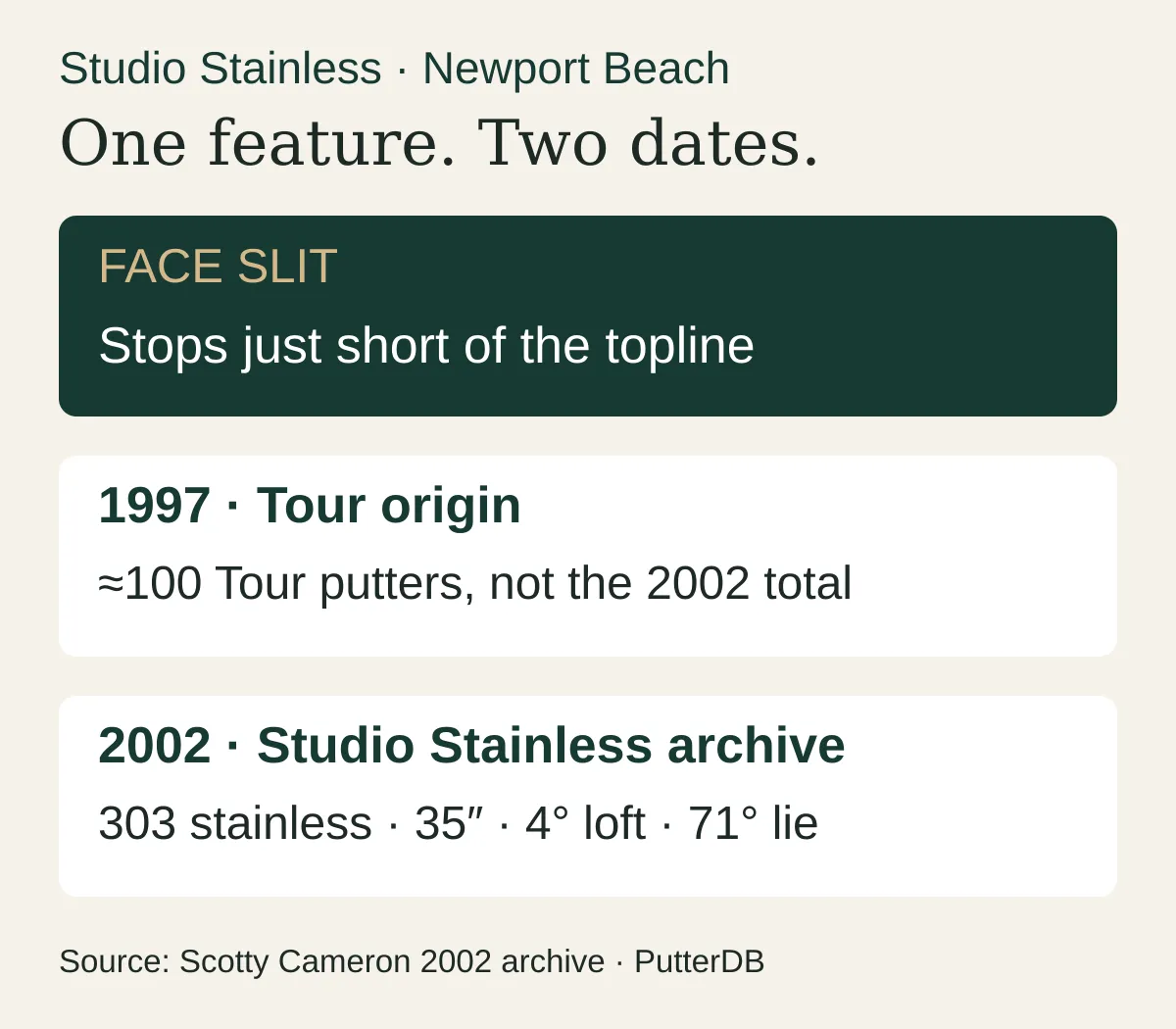
The Studio Stainless Newport Beach is the Newport variant with a slit cut into the face, stopping just short of the topline—the upper edge of the face. Scotty Cameron’s 2002 archive calls the resulting design a “floating face” and describes it as a sound-related feature. The same entry’s reference to approximately 100 putters concerns earlier 1997 Tour examples, not the production total for the 2002 Studio Stainless model.
What is the Studio Stainless Newport Beach sound slot?
The 2002 Newport Beach maker archive describes taking the refined Newport head and cutting a slit into the face, stopping just short of the topline. Collectors commonly call this a sound slot; the maker’s description explains why its location matters.
The archive contrasts this cut with a traditional slit in the flange—the portion of the head extending behind the face. For the Newport Beach, it describes moving the cut closer to the face to manipulate sound pitch. When comparing photographs, look for the Beach cut near the face rather than assuming every sound slot must be an open gap in the rear flange.
The maker attributes a distinctive sound and a change in feel to this “floating face.” That is the manufacturer’s design explanation, not a measured comparison of ball speed or distance control. It does not establish that the Beach will roll the ball farther, feel softer to every player or perform better than a standard Newport.
How does the Beach differ from the standard Newport?
The face slit is the specific Beach feature described in the 2002 archive. The standard 2002 Studio Stainless Newport archive instead describes its refined head contours, a single sightline and a soft beaded-mist finish; it does not describe a Beach slit.
Both entries list the same four basic specifications:
- Head material: milled 303 stainless steel.
- Listed length: 35 inches.
- Loft: 4°.
- Lie: 71°.
Keep those shared specifications separate from model-specific details. For example, the standard Newport description states 1/4 toe hang, but the Beach entry does not state a toe-hang value. A shared Newport ancestry is not a reason to copy every field across.
Does “approximately 100” mean the 2002 model is rare?
No. The Newport Beach archive says the design first originated in 1997, when approximately 100 putters were made for use on Tour. That statement concerns the earlier Tour examples. It supplies neither a total production count nor a rarity ranking for the 2002 Studio Stainless entry.
The original evidence map above separates the two dates. If a seller describes a Studio Stainless Newport Beach as “one of 100,” ask what evidence connects that individual club to the 1997 Tour group. Repeating the archive’s historical sentence does not establish that connection or justify a price premium.
What if a listing says Newport Beach but shows no slot?
Suppose a listing titled “Newport Beach” includes only a cavity photograph. That does not show the cut described by the maker. Request the face-area and address views below, then compare the cut’s location and readable model markings with the 2002 maker gallery.
If the family or “Beach” suffix is missing, open the Newport listing-name finder with unknown choices. It covers four 2002 Studio Stainless editions and the 2005 Studio Style Newport; choose only supported wording rather than treating a visible slit as identity confirmation.
Copy a Beach face-slot evidence request
Select and copy the message below; remove requests for views the seller has already supplied clearly.
Could you give the complete family and model name, including the full suffix, and send clear sole and cavity photos with all markings readable? Please explain any mismatch with the listing title.
Please send a well-lit close-up of the face and the cut near it, with the topline visible, plus an address view showing where the cut sits relative to the face and rear flange. If the cut is obscured, please add another angle rather than only a cavity view.
Has the head been refinished or remilled, or has a slot been added or altered? Please describe any known work and say if the history is unknown. If you claim “one of 100,” what evidence connects this club to the 1997 Tour examples? What supports any claimed production date? Please share any dated purchase, build or service records tied to this club and explain what each records.
An address view looks down at the head. Keep the documented face-slit description separate from a cut observed in a seller photo: a slit alone proves neither factory origin nor authenticity or original build, and an unclear view does not prove the slit is absent. The 2002 archive year identifies the model/edition, not this club’s production date. Keep seller dating claims and club-specific records separate; purchase and service dates record those events, not necessarily manufacture. Leave production date and build history unresolved where unsupported.
Use the listing-research worksheet to keep the seller’s wording, maker documentation and photo observations separate, with open questions about the cut, alterations or claimed Tour provenance.
Research the exact 2002 entries
PutterDB is a free reference for sourced model research. Open the 2002 Studio Stainless Newport Beach record and the standard 2002 Studio Stainless Newport record to follow their specifications and original evidence.
If the question is about head contours rather than the Beach cut, the separate Studio Stainless Newport vs Newport 2 guide covers that distinction.