
TaylorMade TP Reserve B11 Face: Milled, Not an Insert
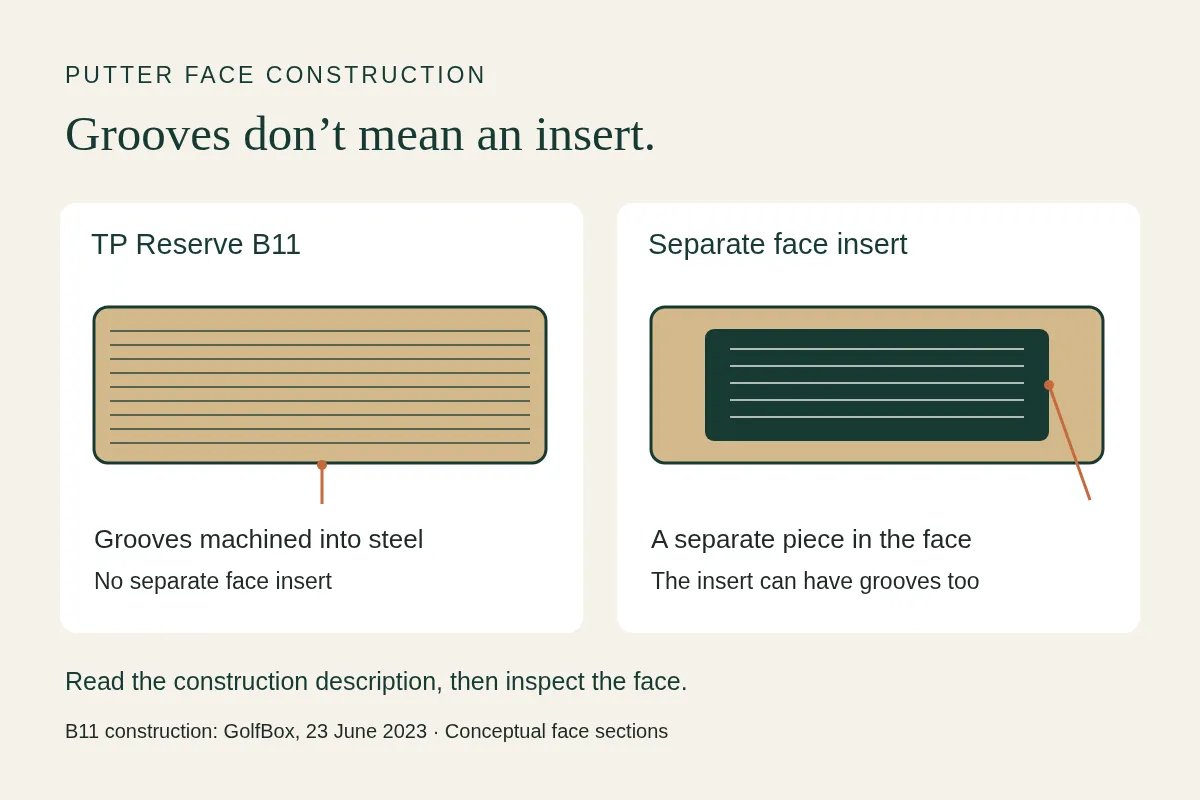
The TaylorMade TP Reserve B11 face is milled steel with machined grooves, rather than a separate face insert. GolfBox’s TP Reserve launch coverage, published on 23 June 2023, describes the range as milled from 303 stainless steel and explicitly says it has no face insert. For a used B11 listing, a description such as “Pure Roll insert” needs clarification before you rely on it.
Does the TP Reserve B11 face have an insert?
The TP Reserve B11 has a grooved metal striking face, not a separate insert fitted into the face. A face insert is a separate piece of material set into a putter’s striking surface. Milling describes machining the material; grooves describe the surface pattern. Neither word, by itself, tells you whether another putter has an insert.
That distinction matters when reading a listing: “milled,” “grooved” and “insert” describe different things. The B11’s machined grooves don’t turn its steel face into an insert, and a grooved insert on another model doesn’t make that model a TP Reserve.
The grooves address sound and feel
Simon Daddow’s TP Reserve review for Today’s Golfer, last updated on 25 March 2025, distinguishes the range’s machined face grooves from TaylorMade’s Pure Roll insert. The review reports that the TP Reserve groove design reduces the face area contacting the ball to influence sound and feel, rather than serving the Pure Roll insert’s stated skid-and-roll purpose.
Those are attributed design descriptions from independent publications. They don’t establish that a B11 will roll better than an insert putter or feel softer to every golfer. If feel is the deciding factor, try the putters with the same ball instead of choosing from the words “steel” and “insert” alone.
A used B11 listing says “Pure Roll insert”
Suppose a seller advertises a “TP Reserve B11, original Pure Roll insert” but supplies only an address photograph—the view looking down at the head. The written description conflicts with the published TP Reserve construction. Keep that conflict in your notes rather than silently correcting the seller’s claim.
Open private browser notes with the B11 catalog record as an evidence candidate. Review its source-labeled evidence and confirm before adding it; the hypothetical seller wording and independent review claims above aren’t imported or turned into manufacturer facts. Prefer to start manually or write on paper? Use the blank browser worksheet or A4/Letter PDFs.
Ask for:
- A straight-on photograph of the whole face, sharp enough to inspect the milling and face edges.
- A sole photograph showing the model markings, plus a neck close-up to help check the full model identity.
- The club’s refinishing or face-work history, and any original purchase documentation the seller has.
You can send:
Could you send a clear, straight-on face photo, a sole photo showing the model markings, and a neck close-up? The TP Reserve coverage describes a milled steel face without a separate insert, so could you clarify the “Pure Roll insert” wording? Please also let me know whether the head has been refinished or the face has had any work.
The seller may have reused a description from another putter. If the photographs and reply still disagree, leave the model or construction unresolved. A familiar groove pattern or plausible sole marking alone doesn’t authenticate the individual club.
Keep the model reference beside the listing evidence
PutterDB’s TP Reserve B11 catalog record retains the secondary catalog’s milled-steel construction and face-material fields with their provenance. Use that reference alongside the seller’s photographs and alteration history; its 2023 catalog label is separate from the history of the particular club you’re considering.
Those catalog fields come from Golf Equipment Database by GolferX, Inc., adapted under CC BY-SA 4.0. Maker and edition labels were normalized and listed values formatted; adapted catalog data carries the same license. The record’s secondary evidence, retrieved on 16 November 2026, stays distinct from the independent publications cited above. A source retrieval date records when evidence was obtained, not when a club was made.