
Specification reference · Free & account-free
Documented putter head weights
Find a model’s listed head weight, with its exact edition and citation. 33 of 105 covered records have a head-weight value.
Manufacturer documentation and uncorroborated secondary catalog claims stay labeled separately. Values retain their listed units; a shared model name does not establish the weight of an individual club.
Search the covered records ↓Find a covered model
5 matching records · 0 with a listed head weight
Clear filtersEditorial measurement guide
First check what the weight measures
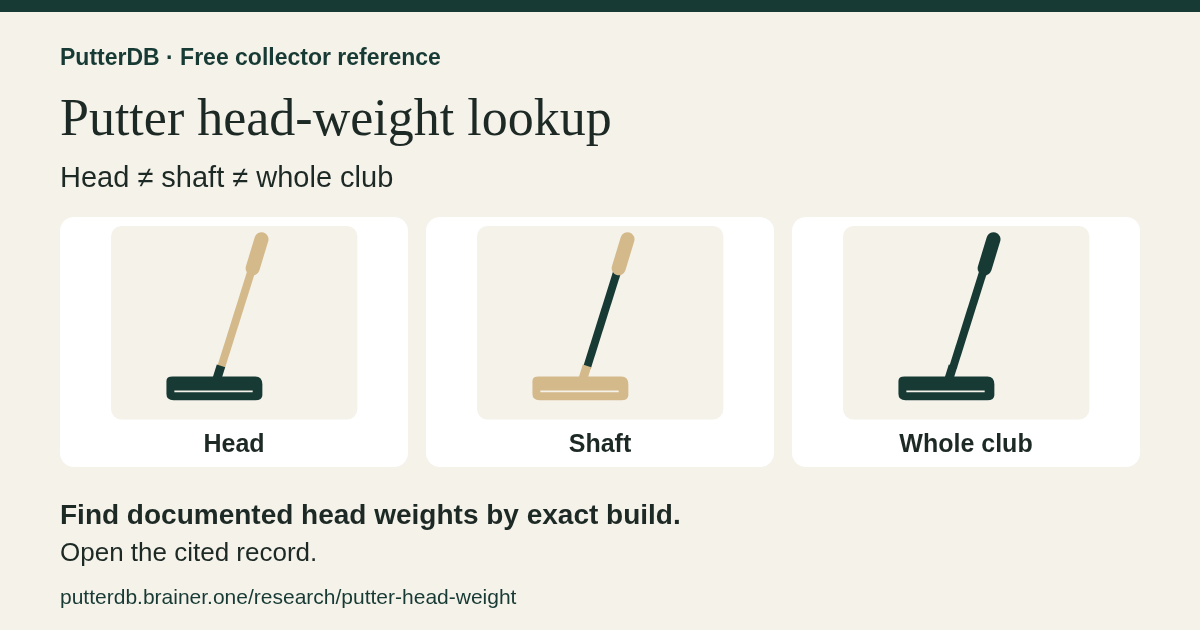
Head, shaft and whole-club weights describe different scopes. The highlighted part below shows each scope; the text gives the same explanation.
Head weight
The head component. Check which head configuration the source describes.
Shaft weight
The shaft component. Keep the source’s stated scope; this is not a head-weight figure.
Whole-club weight
The assembled putter. This is not a head-only figure.
Keep the exact build, original units and citation. An unclear “weight” stays unclear. Do not subtract component figures to invent a head weight; these drawings do not define component boundaries for every build. A weight alone is not a fitting recommendation or an identity or originality verdict.
Find documented head weights in the cited lookup →
Sharing image: accessible text and download
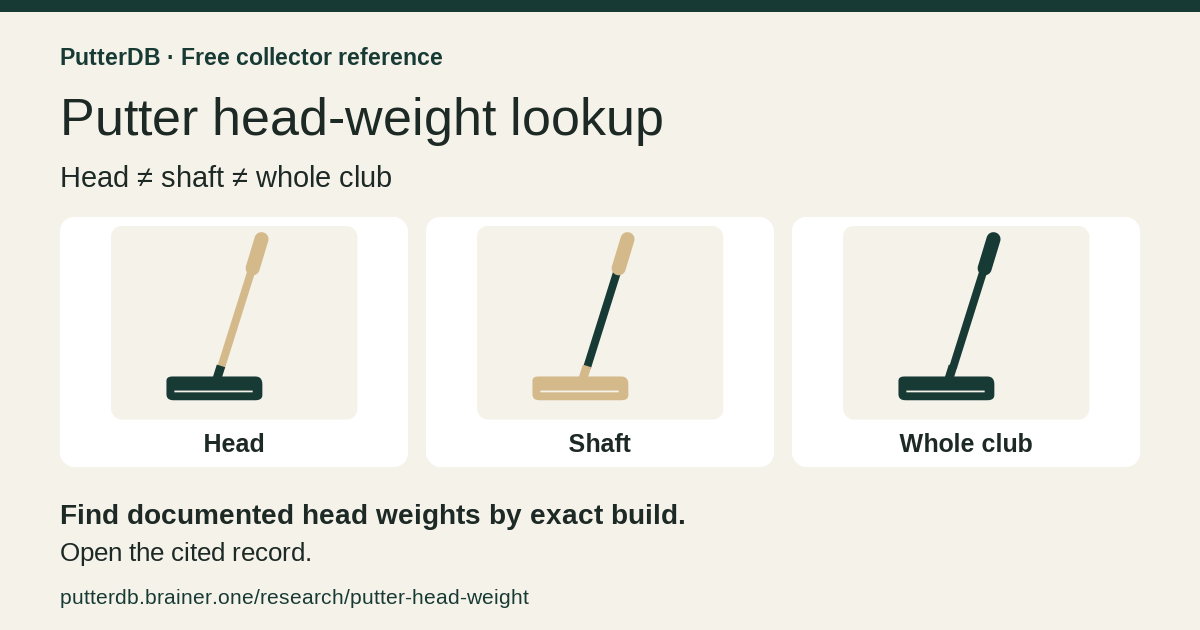
Putter head-weight lookup. Head ≠ shaft ≠ whole club. Find documented head weights by exact build. Open the cited record. Free collector reference: putterdb.brainer.one/research/putter-head-weight.
Open sharing image (PNG · 1200 × 630) · Open original vector artwork (SVG)
Editorial collector guidance · cited examples
Head weight and whole-club weight measure different things
Head weight describes the head in the source’s stated configuration. Whole-club weight describes the assembled putter, including its shaft and grip. A scale photo of an assembled club does not establish its head weight.
- Head weight
- Keep the exact edition, build and original unit attached to the value. A stock specification describes a documented build, not a measurement of the seller’s club.
- Shaft weight / counterbalance
- Shaft weight concerns the shaft component. A separately stated counterbalance concerns an added weight, not the entire shaft or the head. Neither is a whole-club weight.
- Sole weights / interchangeable components
- A component’s weight is not automatically the assembled head’s weight. Check which components the source includes and which are fitted to the listed club; do not calculate a head value from an incomplete parts list.
- Unlabelled “weight”
- If the source does not say what was weighed, leave the scope unresolved. A number in a model name or shaft label does not become a gram specification by itself.
Read the claim in its own evidence
Manufacturer example — Cleveland HB SOFT 2 #1, standard series: the Canadian table lists a 355 g head and separately notes a 20 g shaft counterbalance for putters 35 inches and longer. Keep that length condition with the counterbalance; do not add it to the head-weight answer. Read the cited record →
Manufacturer range context — Mizuno M.CRAFT X: the recorded range evidence describes interchangeable neck, back and sole-weight components. The S4 record leaves head weight unestablished; family-level component information does not fill that gap. Read the exact configuration and range citation →
Secondary example — Vice VGP03 ZT / VGP04 ZT: forgiving.golf lists 380 g for both named right-handed, 34-inch standard builds. They remain different heads, and these are secondary claims, not independently checked manufacturer specifications. VGP03 ZT evidence → VGP04 ZT evidence →
Check the seller’s build before comparing numbers
Record the complete model, edition, handedness and length, plus the current shaft, grip, fitted weights and any reported alterations. Match those details to the cited build rather than borrowing a neighbouring model’s value.
Ask whether the number is a stock specification, a component marking or an actual measurement. For a measurement, request the original unit, what was on the scale and a clear photo showing the object and reading. Keep seller evidence separate from the reference specification.
Record agreements, differences and open questions. A matching number does not establish identity or originality; a mismatch needs build and measurement evidence before it supports a conclusion.
Prepare a seller photo request → Keep claims and cited facts separate in the free worksheet →
Secondary data: Golf Equipment Database by GolferX, Inc., CC BY-SA 4.0; and forgiving.golf, CC BY 4.0. Each claim links to its publisher’s export. PutterDB selected factual fields, normalized maker and edition labels and formatted listed values. Adapted Golf Equipment Database data retains CC BY-SA 4.0.
Download Golf Equipment Database originals & field provenance → · Open an exact record for its full attribution and any reported maker-source mapping. No source photographs or editorial prose are reproduced.